
Slow Metabolism After 40: What’s Really Going On

If you feel like your body just doesn’t respond the way it used to — the same workouts, the same meals, but the scale won’t budge and the afternoon energy crash hits harder than it used to — you’re not imagining it. A slow metabolism after 40 is one of the most common (and most misunderstood) frustrations people bring up, and there are real, measurable reasons behind it. Here’s what’s actually going on, and what tends to help.
Why Does Metabolism Slow Down After 40?
Muscle Mass Naturally Declines (Sarcopenia)
Starting around age 30, adults lose roughly 3-8% of muscle mass per decade — and that rate accelerates after 40. Since muscle tissue burns more calories at rest than fat tissue, less muscle means a lower resting metabolic rate, even if your weight on the scale hasn’t changed. This is one of the biggest — and most fixable — contributors to a slow metabolism after 40.
Hormonal Shifts Change How You Burn Energy
For women, perimenopause and declining estrogen levels are linked to changes in fat distribution and a slower metabolic rate. For men, testosterone levels decline gradually after 30, which is associated with reduced muscle mass and lower energy expenditure. These hormonal shifts are a major reason a slow metabolism after 40 affects men and women somewhat differently, even when lifestyle habits look similar.
Mitochondrial Function Declines With Age
Mitochondria — the structures inside your cells that convert food into usable energy — naturally become less efficient with age, partly due to accumulated oxidative stress. Lower mitochondrial output means your body converts calories into energy less effectively, contributing to both a slower metabolism and the fatigue many people notice more after 40.
Daily Movement (NEAT) Quietly Drops
NEAT — Non-Exercise Activity Thermogenesis — refers to the calories burned through everyday movement like fidgeting, walking to a meeting, or standing while on the phone. Busier, more sedentary lifestyles after 40 (more desk work, less incidental movement) can quietly reduce daily calorie burn by hundreds of calories, without a single change to your workout routine.
Sleep Quality Affects Metabolic Rate
Sleep tends to become lighter and more fragmented with age, and poor sleep is directly linked to reduced insulin sensitivity and lower metabolic efficiency the next day. If you’re dealing with a slow metabolism after 40 and also notice your sleep isn’t what it used to be, the two are very likely connected.
Signs Your Metabolism Has Slowed Down
- Weight creeping up gradually without any change in diet
- Feeling cold more often than you used to
- Afternoon energy crashes that didn’t used to happen
- Slower recovery after exercise
- Difficulty losing weight even with consistent effort
- Fat accumulating more around the midsection than before
Two Common Approaches to Supporting a Slow Metabolism
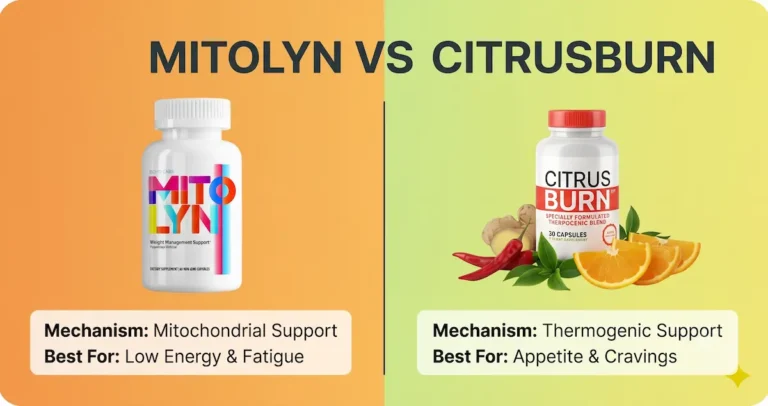
When people look beyond diet and exercise for extra metabolic support, most approaches fall into one of two categories: supporting mitochondrial function (helping cells convert energy more efficiently) or supporting thermogenesis (helping the body generate more heat/calorie burn). We’ve covered both approaches in detail in our Mitolyn review and our CitrusBurn review. Here’s how the two compare conceptually.
Mitochondrial vs Thermogenic Support
| Mitochondrial Support | Thermogenic Support | |
|---|---|---|
| How it works | Targets the cell’s energy-producing structures, aiming to improve how efficiently food and fat convert into usable energy | Aims to raise the body’s internal heat production, encouraging slightly higher calorie burn at rest and during activity |
| Typical ingredients | Antioxidant-rich plant extracts (e.g. astaxanthin, Rhodiola, maqui berry) | Botanicals like bitter orange (p-synephrine), capsaicin, green tea extract |
| Best suited for | Those primarily dealing with low energy and fatigue alongside a slow metabolism | Those primarily dealing with appetite/cravings alongside a slow metabolism |
| Stimulant content | Typically stimulant-free | Varies — some formulas include mild stimulant-adjacent botanicals |
| Example product | Mitolyn | CitrusBurn |
Note: neither approach replaces the fundamentals — resistance training to preserve muscle mass, adequate protein intake, and quality sleep remain the most evidence-backed ways to support metabolism at any age.
How to Support a Slow Metabolism After 40 Naturally
- Prioritize resistance training 2-3x per week to preserve and build muscle mass
- Aim for adequate protein intake (roughly 25-30g per meal) to support muscle maintenance
- Look for ways to add more incidental movement to your day (short walks, standing breaks)
- Protect your sleep — aim for 7-9 hours, and address issues like sleep apnea if suspected
- Manage chronic stress, since elevated cortisol is linked to slower metabolic rate over time
When to See a Doctor About a Slow Metabolism
If you’re experiencing dramatic, unexplained weight changes, extreme fatigue, feeling cold constantly, hair thinning, or other unusual symptoms alongside a slower metabolism, it’s worth ruling out a thyroid condition with your doctor. The American Thyroid Association has a helpful guide on thyroid testing, since hypothyroidism is a common and treatable cause of metabolic slowdown that’s easy to miss.
Frequently Asked Questions About Slow Metabolism After 40
At what age does metabolism start to slow down?
Metabolic rate begins a gradual decline around age 30, but the drop tends to become more noticeable after 40, largely due to muscle loss, hormonal changes, and reduced daily activity.
Can you reverse a slow metabolism after 40?
You can’t fully reverse the natural aging process, but resistance training to rebuild muscle mass, adequate protein intake, quality sleep, and stress management can meaningfully improve metabolic rate at any age.
Does menopause cause a slow metabolism?
Declining estrogen during perimenopause and menopause is associated with changes in fat distribution and a modest decrease in metabolic rate, which is one reason many women notice changes during this transition.
What foods help boost a slow metabolism?
Protein-rich foods have the highest thermic effect (meaning your body burns more calories digesting them), and staying adequately hydrated also supports metabolic function. No single food dramatically “boosts” metabolism on its own.
Is it normal to gain weight after 40 even without eating more?
Yes — this is common and usually reflects the combined effect of muscle loss, hormonal changes, and reduced daily activity levels, all of which lower total calorie burn even when diet stays the same.
The Bottom Line on Slow Metabolism After 40
A slow metabolism after 40 isn’t a personal failing — it’s the combined result of muscle loss, hormonal shifts, declining mitochondrial efficiency, reduced daily movement, and changing sleep patterns. The most reliable fixes are still the fundamentals: resistance training, adequate protein, quality sleep, and stress management. From there, some people look at additional support — whether that’s mitochondrial-focused options like Mitolyn or thermogenic-focused options like CitrusBurn — as one more piece of the puzzle, not a replacement for the basics.